Test
Khabar Hub – Robust coordination needed for reintegration of returnee migrant workers
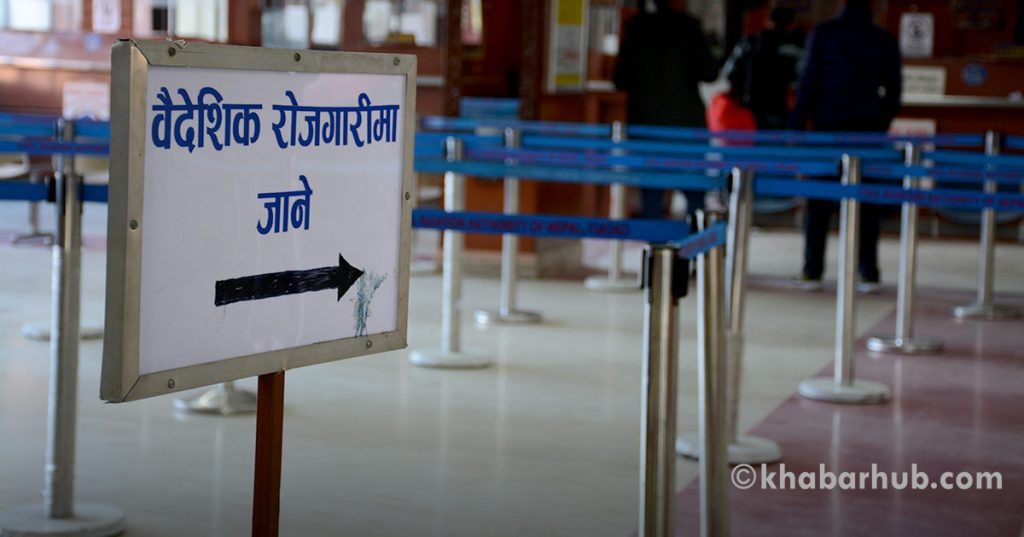
KATHMANDU: With nearly four million Nepalis working abroad and remittances contributing close to a quarter of the national GDP, migrant workers remain a vital pillar of Nepal’s economy. Every day, more than 2,000 Nepalis leave the country in search of better employment opportunities overseas. While foreign employment has boosted remittance inflows, the challenges faced by migrant workers, from departure to return, continue to expose gaps in migration governance. One of the most pressing yet often overlooked aspects is the reintegration of returnee migrant workers into Nepal’s social and economic life. Each year, thousands of Nepalis return home, some with savings, skills, and international work experience, while others come back burdened with debt, trauma, or health issues. Ensuring their dignified reintegration remains a challenge, as repeatedly highlighted by research and media reports. Reintegration pilot gains momentum Although Nepal has long focused on safe migration, structured interventions targeting returnee migrants began relatively late. In July 2022, the government launched the Reintegration of Returnee Migrant Workers (ReMi) project to address this gap. The initiative aims to support returnees through employment, entrepreneurship, and social reintegration, allowing them to utilize skills and experience gained abroad within the domestic workforce. ReMi is a four-year pilot project implemented in 20 local levels across Koshi and Madhesh provinces. It is a bilateral initiative of the governments of Nepal and Switzerland, with technical assistance from Helvetas Nepal. The project aligns with federal policies, including the Reintegration Programme Directives, and assigns defined roles to provincial and local governments, particularly through Employment Service Centres (ESCs). A key feature of the intervention is the coordinated engagement of all three tiers of government, focusing on economic, social, and structural empowerment of returnee migrants. Achievements at the local level With only a few months remaining in the first phase, ReMi has helped establish systems for fully functional ESCs in all target local governments. These centers now serve as first-entry points for returnees seeking counseling, referrals, and support. Team Leader of ReMi at Helvetas Nepal, Madushika Lansakara, said the ESCs have been trained to provide guidance on skills training, job placement, business development, financial literacy, and psychosocial support. Many returnees, she noted, have benefited from entrepreneurship training and facilitation of soft loans through local governments. The project has also recorded notable social reintegration successes. One case from Katari Municipality in Udayapur involved a male returnee who had suffered severe mental health issues after facing illegal labor conditions abroad. Through counseling, medical support, and financial assistance facilitated by ReMi, his health condition improved significantly. Training programs in poultry farming, goat rearing, tea cultivation, and entrepreneurship have particularly attracted women returnees. According to project data, 16,853 individuals were reached through awareness and orientation programs, while 3,030 returnee migrants registered at local governments to receive reintegration services. Persistent challenges Despite positive outcomes, structural challenges persist. The Nepali labor market still lacks sufficient capacity to absorb returnees into quality, well-paying jobs, increasing the risk of re-migration. Other challenges include skills mismatch, underutilization of experience gained abroad, social stigma, especially against women returnees, psychological stress, limited institutional sustainability, and inadequate resource mobilization across government tiers. Scaling up efforts The Ministry of Labour, Employment and Social Security (MoLESS) is exploring ways to strengthen reintegration efforts through improved data integration. Joint Secretary Krishna Prasad Sapkota said the ministry is working to build on existing immigration records to create more comprehensive datasets that would enable better support for returnees. Calling ReMi a pilot initiative, Sapkota said the government is preparing to expand the model across all 753 local levels. He said reintegration activities are being integrated into the National Employment Programme and reflected in the national budget. “Learning from past interventions, the government aims to make local levels fully responsible for implementation, while federal and provincial governments focus on monitoring and facilitation,” he said, adding that the second phase of ReMi after July 2026 would be implemented at full scale with strong emphasis on digitization. At the local level, ReMi project coordinator at Diktel Rupakot Majhuwagadhi Municipality in Khotang, Ojan Babu Acharya, said awareness-raising remains a priority to ensure smoother community reintegration. He stressed the need to focus on younger early returnees, who are more likely to adapt quickly and engage in entrepreneurship. However, he identified the lack of reliable data as a major obstacle. Way forward The mixed experiences from the pilot project reinforce that reintegration is a crucial component of migration governance. Ensuring decent livelihoods, financial stability, social dignity, good health, and entrepreneurial opportunities for returnee migrant workers requires robust coordination among all three tiers of government. As Nepal continues to rely heavily on foreign employment, strengthening reintegration mechanisms is no longer optional, it is an urgent national necessity.
Gothalo Khabar – Robust coordination awaited for reintegration of returnee migrant workers

Kathmandu, 17 Dec 2025: Nearly four million Nepalis are working abroad, sending remittance to sustain the national economy. The migrant workers are indeed major pillars of economy at home because nearly 25 percent of GDP is fed by the remittance they send from abroad. More than 2,000 Nepalis leave the country every day for better jobs. Taking into account the remittance flow to the country, such outmigration has been a boon to economy, while the stories about host of challenges they face from Nepal to the countries of destination draw equal concern, thereby pointing out the urgency of better governance of migration. One of the pressing parts of the migration governance is the reintegration of the migrant returnees in the country. Many Nepalis return home – some with money, skills and experience, and some others with rising debt and plight – aspiring respectable reintegration in the society. But whether they are integrated in the society well with social and financial opportunities in the country and live up to their expectation is still a challenge as the research studies and media stories have revealed from time to time. Piloting on reintegration Although issues and interventions on safe migration were surfaced and launched long back, intervention on returnee migrants came late. The Reintegration of Returnee Migrant Workers (ReMi) is the very project that Nepal government launched in July 2022 by taking into account the issues and concerns of returnee migrant workers. It aimed at engaging the returnee migrants in employment and entrepreneurship along with comfortable reintegration in family and community. With this, they could be treated as a vital workforce within the country where they utilize their skills and experience gained abroad. A four-year pilot project, covering 20 local levels of Koshi and Madhesh Provinces, is a bilateral initiative of the governments of Nepal and Switzerland to which technical assistance is provided by Helvetas Nepal. In order to enforce the intervention, there are policies and directives from the Federal Government (e.g., the Reintegration Programme Directives), outlining specific roles for Provincial and Local Governments, like leveraging Employment Service Centres (ESCs) as key service delivery points. The salient feature of the intervention is the engagement of all three-tiers of government. The intervention aimed at empowering the returnee migrants to cope with the economic, social, and structural obstacles.Achievements Sharing the achievement of the project that has few months left for the completion of the first phase, Team Leader of ReMi at Helvetas Nepal, Madushika Lansakara, informed about the establishment of systems and processes for the full functioning of Employment Service Centres (ESCs) in target local governments so that they could provide counselling, support and referrals to services for returned migrant workers and their families. “These ESCs in 20 local governments have been trained and equipped to act as the first entry points for returnees seeking guidance, offering referrals for skills training, job placements, business development skills, financial literacy and psychosocial support. Many returnees have benefitted through entrepreneurship training and facilitation for soft loans. The local governments facilitate for such loans,” she added. A poignant case the ReMi Project shared was the rescue of a male- preventing a man returned from foreign job from sliding to a severe mental health condition. It was observed at Katari Municipality of Udayapur in Koshi Province. He had fallen victim to illegal labour condition overseas, resulting in a prolonged worsening of mental health. ReMi’s facilitation to his medication with counselling and financial help ensured him remarkable progress in his health status. It was one of the successful cases of social reintegration, a vital part of the activity. Training in poultry, goat farming, tea farm and entrepreneurship are other schemes that have attracted the women returnee migrants. As many as 16,853 persons were reached out through orientation and awareness under this scheme. Similarly, 3,030 returnee migrants registered at 20 local governments to receive reintegration support and services.Challenges awaiting address Irrespective of the positive impacts the project has created, challenges cannot be denied. The challenges exist in collective and multifaceted manner. The ReMi Project has observed that the most critical is the structural economic challenge: Nepali labour market currently lacks the capacity to absorb all returnees into high-quality, well-paying jobs, leading to a high temptation to re-migrate. Skills utilization, mismatch of skills gained abroad, social and psychological stigma, especially toward women returnees, lack of sustained institutional set up and resource mobilization across all government tiers are issues to address well. In this connection, there is an opportunity to complement Nepali media’s focus on politics by highlighting social narratives like migrant reintegration. As Team Leader Lansakara notes, sustained reporting on returnee success stories can powerfully shift public perceptions. Similarly, for strengthening the efforts, Ministry of Labour, Employment and Social Security (MoLESS) and related partners are identifying ways to enhance data integration. Joint Secretary at MoLESS, Krishna Prasad Sapkota, highlighted the potential to build on existing immigration records, creating more comprehensive datasets that allow the Ministry and local partners to better support returnees. Sapkota argues it is just a pilot project, so we’re planning its expansion across all 753 levels. “The Ministry is evaluating the project. Learning from the past intervention, government is for making local level fully responsible in enforcing the activities while the federal and provincial ones in a role of monitoring and facilitation. Now onwards, government is integrating the ReMi under its National Employment Programme which is also in the national budget,” he explained. The experience of the pilot project has made us engage private sector, seek further responsible role of local levels and make the intervention result-oriented, Sapkota said, adding that the second phase after July 2026 would be in full scale. “Digitization is given a high priority for scaling up the intervention that helps builds Nepal’s labour market information system,” he informed. ReMi is also supporting actively to the MoLESS for this cause. Moreover, ReMi project coordinator at Diktel Rupakot Majhuwagadhi municipality of Khotang district, Ojan Babu Acharya, said they were largely focusing on awareness raising at local level
News Abhiyan – Robust coordination awaited for reintegration of returnee migrant workers

Kathmandu, Dec 17: Nearly four million Nepalis are working abroad, sending remittance to sustain the national economy. The migrant workers are indeed major pillars of economy at home because nearly 25 percent of GDP is fed by the remittance they send from abroad. More than 2,000 Nepalis leave the country every day for better jobs. Taking into account the remittance flow to the country, such outmigration has been a boon to economy, while the stories about host of challenges they face from Nepal to the countries of destination draw equal concern, thereby pointing out the urgency of better governance of migration. One of the pressing parts of the migration governance is the reintegration of the migrant returnees in the country. Many Nepalis return home – some with money, skills and experience, and some others with rising debt and plight – aspiring respectable reintegration in the society. But whether they are integrated in the society well with social and financial opportunities in the country and live up to their expectation is still a challenge as the research studies and media stories have revealed from time to time. Piloting on reintegration Although issues and interventions on safe migration were surfaced and launched long back, intervention on returnee migrants came late. The Reintegration of Returnee Migrant Workers (ReMi) is the very project that Nepal government launched in July 2022 by taking into account the issues and concerns of returnee migrant workers. It aimed at engaging the returnee migrants in employment and entrepreneurship along with comfortable reintegration in family and community. With this, they could be treated as a vital workforce within the country where they utilize their skills and experience gained abroad. A four-year pilot project, covering 20 local levels of Koshi and Madhesh Provinces, is a bilateral initiative of the governments of Nepal and Switzerland to which technical assistance is provided by Helvetas Nepal. In order to enforce the intervention, there are policies and directives from the Federal Government (e.g., the Reintegration Programme Directives), outlining specific roles for Provincial and Local Governments, like leveraging Employment Service Centres (ESCs) as key service delivery points. The salient feature of the intervention is the engagement of all three-tiers of government. The intervention aimed at empowering the returnee migrants to cope with the economic, social, and structural obstacles. Achievements Sharing the achievement of the project that has few months left for the completion of the first phase, Team Leader of ReMi at Helvetas Nepal, Madushika Lansakara, informed about the establishment of systems and processes for the full functioning of Employment Service Centres (ESCs) in target local governments so that they could provide counselling, support and referrals to services for returned migrant workers and their families. “These ESCs in 20 local governments have been trained and equipped to act as the first entry points for returnees seeking guidance, offering referrals for skills training, job placements, business development skills, financial literacy and psychosocial support. Many returnees have benefitted through entrepreneurship training and facilitation for soft loans. The local governments facilitate for such loans,” she added. A poignant case the ReMi Project shared was the rescue of a male- preventing a man returned from foreign job from sliding to a severe mental health condition. It was observed at Katari Municipality of Udayapur in Koshi Province. He had fallen victim to illegal labour condition overseas, resulting in a prolonged worsening of mental health. ReMi’s facilitation to his medication with counselling and financial help ensured him remarkable progress in his health status. It was one of the successful cases of social reintegration, a vital part of the activity. Training in poultry, goat farming, tea farm and entrepreneurship are other schemes that have attracted the women returnee migrants. As many as 16,853 persons were reached out through orientation and awareness under this scheme. Similarly, 3,030 returnee migrants registered at 20 local governments to receive reintegration support and services.Challenges awaiting address Irrespective of the positive impacts the project has created, challenges cannot be denied. The challenges exist in collective and multifaceted manner. The ReMi Project has observed that the most critical is the structural economic challenge: Nepali labour market currently lacks the capacity to absorb all returnees into high-quality, well-paying jobs, leading to a high temptation to re-migrate. Skills utilization, mismatch of skills gained abroad, social and psychological stigma, especially toward women returnees, lack of sustained institutional set up and resource mobilization across all government tiers are issues to address well. In this connection, there is an opportunity to complement Nepali media’s focus on politics by highlighting social narratives like migrant reintegration. As Team Leader Lansakara notes, sustained reporting on returnee success stories can powerfully shift public perceptions. Similarly, for strengthening the efforts, Ministry of Labour, Employment and Social Security (MoLESS) and related partners are identifying ways to enhance data integration. Joint Secretary at MoLESS, Krishna Prasad Sapkota, highlighted the potential to build on existing immigration records, creating more comprehensive datasets that allow the Ministry and local partners to better support returnees. Sapkota argues it is just a pilot project, so we’re planning its expansion across all 753 levels. “The Ministry is evaluating the project. Learning from the past intervention, government is for making local level fully responsible in enforcing the activities while the federal and provincial ones in a role of monitoring and facilitation. Now onwards, government is integrating the ReMi under its National Employment Programme which is also in the national budget,” he explained. The experience of the pilot project has made us engage private sector, seek further responsible role of local levels and make the intervention result-oriented, Sapkota said, adding that the second phase after July 2026 would be in full scale. “Digitization is given a high priority for scaling up the intervention that helps builds Nepal’s labour market information system,” he informed. ReMi is also supporting actively to the MoLESS for this cause. Moreover, ReMi project coordinator at Diktel Rupakot Majhuwagadhi municipality of Khotang district, Ojan Babu Acharya, said they were largely focusing on awareness raising at local level so
Ratopati – Robust coordination awaited for reintegration of returnee migrant workers
Kathmandu, Dec 17: Nearly four million Nepalis are working abroad, sending remittance to sustain the national economy. The migrant workers are indeed major pillars of economy at home because nearly 25 percent of GDP is fed by the remittance they send from abroad. More than 2,000 Nepalis leave the country every day for better jobs. Taking into account the remittance flow to the country, such outmigration has been a boon to economy, while the stories about host of challenges they face from Nepal to the countries of destination draw equal concern, thereby pointing out the urgency of better governance of migration. One of the pressing parts of the migration governance is the reintegration of the migrant returnees in the country. Many Nepalis return home – some with money, skills and experience, and some others with rising debt and plight – aspiring respectable reintegration in the society. But whether they are integrated in the society well with social and financial opportunities in the country and live up to their expectation is still a challenge as the research studies and media stories have revealed from time to time. Piloting on reintegration Although issues and interventions on safe migration were surfaced and launched long back, intervention on returnee migrants came late. The Reintegration of Returnee Migrant Workers (ReMi) is the very project that Nepal government launched in July 2022 by taking into account the issues and concerns of returnee migrant workers. It aimed at engaging the returnee migrants in employment and entrepreneurship along with comfortable reintegration in family and community. With this, they could be treated as a vital workforce within the country where they utilize their skills and experience gained abroad. A four-year pilot project, covering 20 local levels of Koshi and Madhesh Provinces, is a bilateral initiative of the governments of Nepal and Switzerland to which technical assistance is provided by Helvetas Nepal. In order to enforce the intervention, there are policies and directives from the Federal Government (e.g., the Reintegration Programme Directives), outlining specific roles for Provincial and Local Governments, like leveraging Employment Service Centres (ESCs) as key service delivery points. The salient feature of the intervention is the engagement of all three-tiers of government. The intervention aimed at empowering the returnee migrants to cope with the economic, social, and structural obstacles. Achievements Sharing the achievement of the project that has few months left for the completion of the first phase, Team Leader of ReMi at Helvetas Nepal, Madushika Lansakara, informed about the establishment of systems and processes for the full functioning of Employment Service Centres (ESCs) in target local governments so that they could provide counselling, support and referrals to services for returned migrant workers and their families. “These ESCs in 20 local governments have been trained and equipped to act as the first entry points for returnees seeking guidance, offering referrals for skills training, job placements, business development skills, financial literacy and psychosocial support. Many returnees have benefitted through entrepreneurship training and facilitation for soft loans. The local governments facilitate for such loans,” she added. A poignant case the ReMi Project shared was the rescue of a male- preventing a man returned from foreign job from sliding to a severe mental health condition. It was observed at Katari Municipality of Udayapur in Koshi Province. He had fallen victim to illegal labour condition overseas, resulting in a prolonged worsening of mental health. ReMi’s facilitation to his medication with counselling and financial help ensured him remarkable progress in his health status. It was one of the successful cases of social reintegration, a vital part of the activity. Training in poultry, goat farming, tea farm and entrepreneurship are other schemes that have attracted the women returnee migrants. As many as 16,853 persons were reached out through orientation and awareness under this scheme. Similarly, 3,030 returnee migrants registered at 20 local governments to receive reintegration support and services. Challenges awaiting address Irrespective of the positive impacts the project has created, challenges cannot be denied. The challenges exist in collective and multifaceted manner. The ReMi Project has observed that the most critical is the structural economic challenge: Nepali labour market currently lacks the capacity to absorb all returnees into high-quality, well-paying jobs, leading to a high temptation to re-migrate. Skills utilization, mismatch of skills gained abroad, social and psychological stigma, especially toward women returnees, lack of sustained institutional set up and resource mobilization across all government tiers are issues to address well. In this connection, there is an opportunity to complement Nepali media’s focus on politics by highlighting social narratives like migrant reintegration. As Team Leader Lansakara notes, sustained reporting on returnee success stories can powerfully shift public perceptions. Similarly, for strengthening the efforts, Ministry of Labour, Employment and Social Security (MoLESS) and related partners are identifying ways to enhance data integration. Joint Secretary at MoLESS, Krishna Prasad Sapkota, highlighted the potential to build on existing immigration records, creating more comprehensive datasets that allow the Ministry and local partners to better support returnees. Sapkota argues it is just a pilot project, so we’re planning its expansion across all 753 levels. “The Ministry is evaluating the project. Learning from the past intervention, government is for making local level fully responsible in enforcing the activities while the federal and provincial ones in a role of monitoring and facilitation. Now onwards, government is integrating the ReMi under its National Employment Programme which is also in the national budget,” he explained. The experience of the pilot project has made us engage private sector, seek further responsible role of local levels and make the intervention result-oriented, Sapkota said, adding that the second phase after July 2026 would be in full scale. “Digitization is given a high priority for scaling up the intervention that helps builds Nepal’s labour market information system,” he informed. ReMi is also supporting actively to the MoLESS for this cause. Moreover, ReMi project coordinator at Diktel Rupakot Majhuwagadhi municipality of Khotang district, Ojan Babu Acharya, said they were largely focusing on awareness raising at
The Rising Nepal – Robust coordination awaited for reintegration of returnee migrant workers
Kathmandu, Dec 17: Nearly four million Nepalis are working abroad, sending remittance to sustain the national economy. The migrant workers are indeed major pillars of economy at home because nearly 25 percent of GDP is fed by the remittance they send from abroad. More than 2,000 Nepalis leave the country every day for better jobs. Taking into account the remittance flow to the country, such outmigration has been a boon to economy, while the stories about host of challenges they face from Nepal to the countries of destination draw equal concern, thereby pointing out the urgency of better governance of migration. One of the pressing parts of the migration governance is the reintegration of the migrant returnees in the country. Many Nepalis return home – some with money, skills and experience, and some others with rising debt and plight – aspiring respectable reintegration in the society. But whether they are integrated in the society well with social and financial opportunities in the country and live up to their expectation is still a challenge as the research studies and media stories have revealed from time to time. Piloting on reintegration Although issues and interventions on safe migration were surfaced and launched long back, intervention on returnee migrants came late. The Reintegration of Returnee Migrant Workers (ReMi) is the very project that Nepal government launched in July 2022 by taking into account the issues and concerns of returnee migrant workers. It aimed at engaging the returnee migrants in employment and entrepreneurship along with comfortable reintegration in family and community. With this, they could be treated as a vital workforce within the country where they utilize their skills and experience gained abroad. A four-year pilot project, covering 20 local levels of Koshi and Madhesh Provinces, is a bilateral initiative of the governments of Nepal and Switzerland to which technical assistance is provided by Helvetas Nepal. In order to enforce the intervention, there are policies and directives from the Federal Government (e.g., the Reintegration Programme Directives), outlining specific roles for Provincial and Local Governments, like leveraging Employment Service Centres (ESCs) as key service delivery points. The salient feature of the intervention is the engagement of all three-tiers of government. The intervention aimed at empowering the returnee migrants to cope with the economic, social, and structural obstacles. Achievements Sharing the achievement of the project that has few months left for the completion of the first phase, Team Leader of ReMi at Helvetas Nepal, Madushika Lansakara, informed about the establishment of systems and processes for the full functioning of Employment Service Centres (ESCs) in target local governments so that they could provide counselling, support and referrals to services for returned migrant workers and their families. “These ESCs in 20 local governments have been trained and equipped to act as the first entry points for returnees seeking guidance, offering referrals for skills training, job placements, business development skills, financial literacy and psychosocial support. Many returnees have benefitted through entrepreneurship training and facilitation for soft loans. The local governments facilitate for such loans,” she added. A poignant case the ReMi Project shared was the rescue of a male- preventing a man returned from foreign job from sliding to a severe mental health condition. It was observed at Katari Municipality of Udayapur in Koshi Province. He had fallen victim to illegal labour condition overseas, resulting in a prolonged worsening of mental health. ReMi’s facilitation to his medication with counselling and financial help ensured him remarkable progress in his health status. It was one of the successful cases of social reintegration, a vital part of the activity. Training in poultry, goat farming, tea farm and entrepreneurship are other schemes that have attracted the women returnee migrants. As many as 16,853 persons were reached out through orientation and awareness under this scheme. Similarly, 3,030 returnee migrants registered at 20 local governments to receive reintegration support and services. Challenges awaiting address Irrespective of the positive impacts the project has created, challenges cannot be denied. The challenges exist in collective and multifaceted manner. The ReMi Project has observed that the most critical is the structural economic challenge: Nepali labour market currently lacks the capacity to absorb all returnees into high-quality, well-paying jobs, leading to a high temptation to re-migrate. Skills utilization, mismatch of skills gained abroad, social and psychological stigma, especially toward women returnees, lack of sustained institutional set up and resource mobilization across all government tiers are issues to address well. In this connection, there is an opportunity to complement Nepali media’s focus on politics by highlighting social narratives like migrant reintegration. As Team Leader Lansakara notes, sustained reporting on returnee success stories can powerfully shift public perceptions. Similarly, for strengthening the efforts, Ministry of Labour, Employment and Social Security (MoLESS) and related partners are identifying ways to enhance data integration. Joint Secretary at MoLESS, Krishna Prasad Sapkota, highlighted the potential to build on existing immigration records, creating more comprehensive datasets that allow the Ministry and local partners to better support returnees. Sapkota argues it is just a pilot project, so we’re planning its expansion across all 753 levels. “The Ministry is evaluating the project. Learning from the past intervention, government is for making local level fully responsible in enforcing the activities while the federal and provincial ones in a role of monitoring and facilitation. Now onwards, government is integrating the ReMi under its National Employment Programme which is also in the national budget,” he explained. The experience of the pilot project has made us engage private sector, seek further responsible role of local levels and make the intervention result-oriented, Sapkota said, adding that the second phase after July 2026 would be in full scale. “Digitization is given a high priority for scaling up the intervention that helps builds Nepal’s labour market information system,” he informed. ReMi is also supporting actively to the MoLESS for this cause. Moreover, ReMi project coordinator at Diktel Rupakot Majhuwagadhi municipality of Khotang district, Ojan Babu Acharya, said they were largely focusing on awareness raising at